Every action is logged. Every site has its own permissions. The vault stays encrypted. Sync never sends plaintext anywhere.
An AI that can browse the open web is powerful. It’s also dangerous if you can’t control it. So we built the controls first.
The agent pauses before sensitive actions — file writes, payments, destructive commands — and waits for your tap.
Allow Gmail reads automatically. Require approval for Gmail sends. Block third-party MCP servers entirely. Each service is its own policy.
Within a service, control which actions need approval. Let the agent read calendars without prompting; require approval to delete events.
When the agent is acting in chat, you can scope rules to which agent is asking — tighter for "research" agents, looser for "primary" agents.
Daily and per-task token budgets. Hit the cap, the agent stops. No silent overruns.
Every page the agent reads is scanned for prompt-injection, hidden instructions, exfiltration phrasing, zero-width tricks, and token-flood payloads. Detections raise an in-app alert and are logged to the threat log in Settings, where you can review and dismiss them.
You don’t need to trust the agent. You can verify it.
Tool name, arguments, result, timestamp, agent identity. Persisted in a local SQLite log.
Filter by tool, by agent, by time range. Find every Gmail send, every file write, every navigation.
Click any audit row to jump to the chat turn that triggered it.
The audit log lives on your disk. Nothing is sent to the cloud. Future sync will be E2E like the vault.
You decide what the agent can do on each site. Read pages, click links, fill forms, autofill credentials — each is a separate toggle.
Allow the agent to extract content from this site. Off by default for sensitive sites (banking, health).
Allow the agent to click links and buttons.
Allow the agent to fill forms (search boxes, drafts).
Allow the agent to use saved passwords. Off by default. Requires a per-site explicit grant.
Configured "safe" directories where local-files skills can read and write. Outside the zones, file ops fail closed.
Click the shield in the address bar for a unified view: current permissions, tracker count, cookies, ad-block status, mute, forget-this-site.
Egg blocks tracking before content even loads. Always-on protections plus optional, more aggressive layers.
~90 known ad/tracker domains blocked at the network layer. Per-site whitelist via the shield panel.
40+ tracking params (utm_*, fbclid, gclid, msclkid, ...) stripped from URLs on load and on copy.
Sites that route you through tracker domains to set cookies are detected and skipped.
Tighter Referer policy than Chromium default. Sites can’t see exactly where you came from.
Browsers ping ad networks before you click. Egg blocks that.
Sites can’t silently read your clipboard. Pasting requires user action.
Hide your local IP from sites that abuse WebRTC’s ICE candidates.
Block DeviceOrientationEvent, DeviceMotionEvent, ambient light. Useful for fingerprinting resistance.
Dismiss EU cookie banners automatically without clicking Accept All.
None → Basic → Balanced (default) → Strict. Per-profile setting.
Sometimes you don’t want privacy as a global toggle — you want it as a per-site decision.
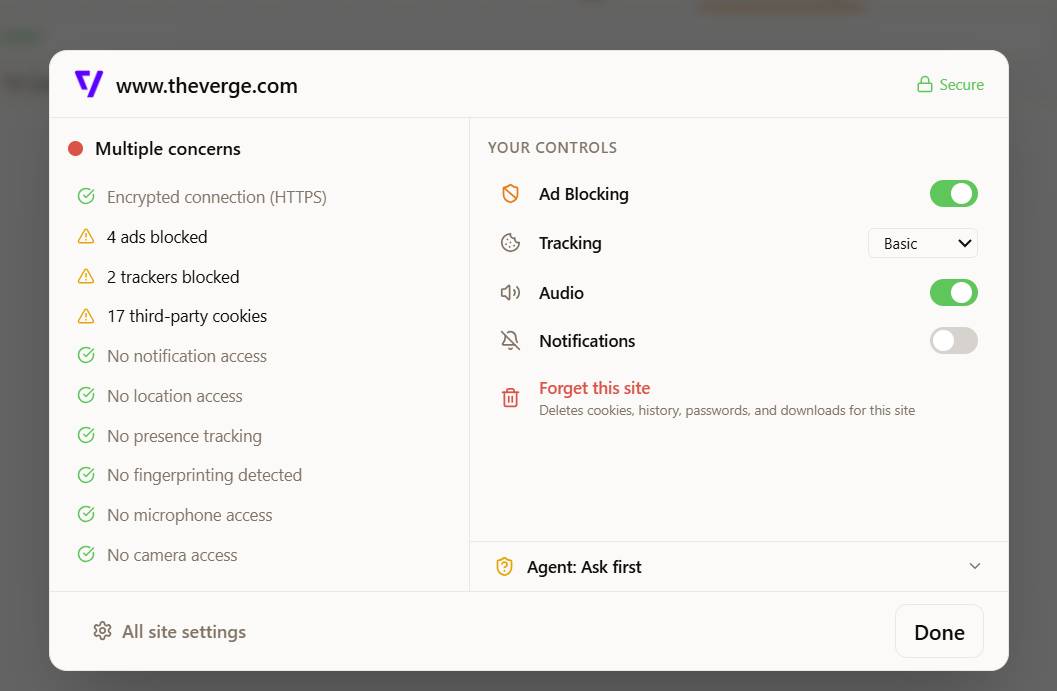
Disable ad-blocking on sites you want to support. Re-enable elsewhere.
One click removes all cookies, storage, history, cache, and saved data for a site.
Auto-muted sites, persistent across sessions.
View, search, edit, and delete cookies per site. Same panel as the site permissions.
Per-tab toggle to make a backgrounded site keep working without throttling.
Passwords, passkeys, and sync blobs are end-to-end encrypted. The cloud relay only ever sees ciphertext.
Master-password protected. Locked vaults park sync deliveries in a pending queue and drain on unlock — nothing decrypts before you authenticate.
Passkeys are stored encrypted. Two AAGUIDs — one for synced, one for device-bound.
AES-256-GCM with X25519 ECDH key exchange between paired devices. The cloud holds opaque blobs only. No account, no master server.
Monotonic counters on every sync envelope so attackers can’t replay an old encrypted blob.
Short Authentication String (SAS) verification on first connect — you confirm a 6-character code matches on both devices.
Only keys explicitly marked syncable cross devices. Local-only keys (file paths, install state) stay put.
If the agent is buying things, it’s spending real money. The wallet enforces ceilings before the firewall even gets the request.
Daily, weekly, monthly caps on agent-initiated payments. Hard stop, not soft warn.
Allow this merchant up to $X. Block that one entirely. Require manual approval over $Y.
Restrict which saved cards the agent can use. Lock high-balance accounts to manual approval.
Every agent-initiated payment lands in the audit log with merchant, amount, and approval chain.
No usage analytics. No crash reports phoned home by default. No "AI improvement" data sharing.
The Egg app and Gateway daemon don’t send usage events anywhere. The cloud relay only carries E2E-encrypted sync.
Crash dumps land on your disk. You can review them, opt to share, or delete.
BYOK keys hit the model provider directly — no Egg-operated proxy in the path. The 3rd-party services we proxy (TTS, places, etc.) are clearly listed in Settings.
Egg works without an account. Account features (sync invites, publish links) layer on if you want them.
Free to download. Bring your own API key.
Download for WindowsAlso available for macOS